Embedded Development · 2022/23
Braillebuddy
Bachelor Thesis HCI - LMU Munich
A compact tangible user interface that facilitates children’s self-directed exploration of Braille. Published at the ACM CHI Conference on Human Factors in Computing Systems 2023.
Motivation
For children with severe visual impairments, access to written language is limited. While screen readers and audio tools offer workarounds, they can’t replace Braille’s role in fostering independence, education, and literacy. But learning Braille is hard and practice-intensive.
I wanted to explore whether Tangible User Interfaces (TUIs) could offer a more engaging and independent way to support Braille learning. TUIs combine digital feedback with physical interaction. That combination has great potential, especially for children who rely more on touch than sight.
On a personal note, I was also simply drawn to the aesthetic and tactile beauty of Braille.


Approach
I followed a User-Centered Design process to understand how children with visual impairments learn Braille. The project was developed in close exchange with special education teachers, students and accessibility researchers, who helped define the educational, tactile, and practical requirements for the prototype.
Through research, concept development, and iterative prototyping, I explored how Braille learning could become more independent and engaging. As a result, I defined three key design requirements that shaped the final prototype and helped translate the research insights into tangible design decisions.
Robust and appealing form factor.
The TUI should be self-contained and easy to use independently without screens or setup. A durable build, along with tactile and visual appeal, supports blind children and invites sighted peers for inclusive play.
Clear physical affordances.
Elements follow standard Braille sizing for accurate recognition, because oversized characters can distort tactile learning. Beveled corners and clear slot guidance keep interaction intuitive and error resistant.
Modular learning system.
The TUI should offer multiple game modes and a scalable card system, so it remains flexible, engaging, and expandable for learners with different skill levels.


Prototype
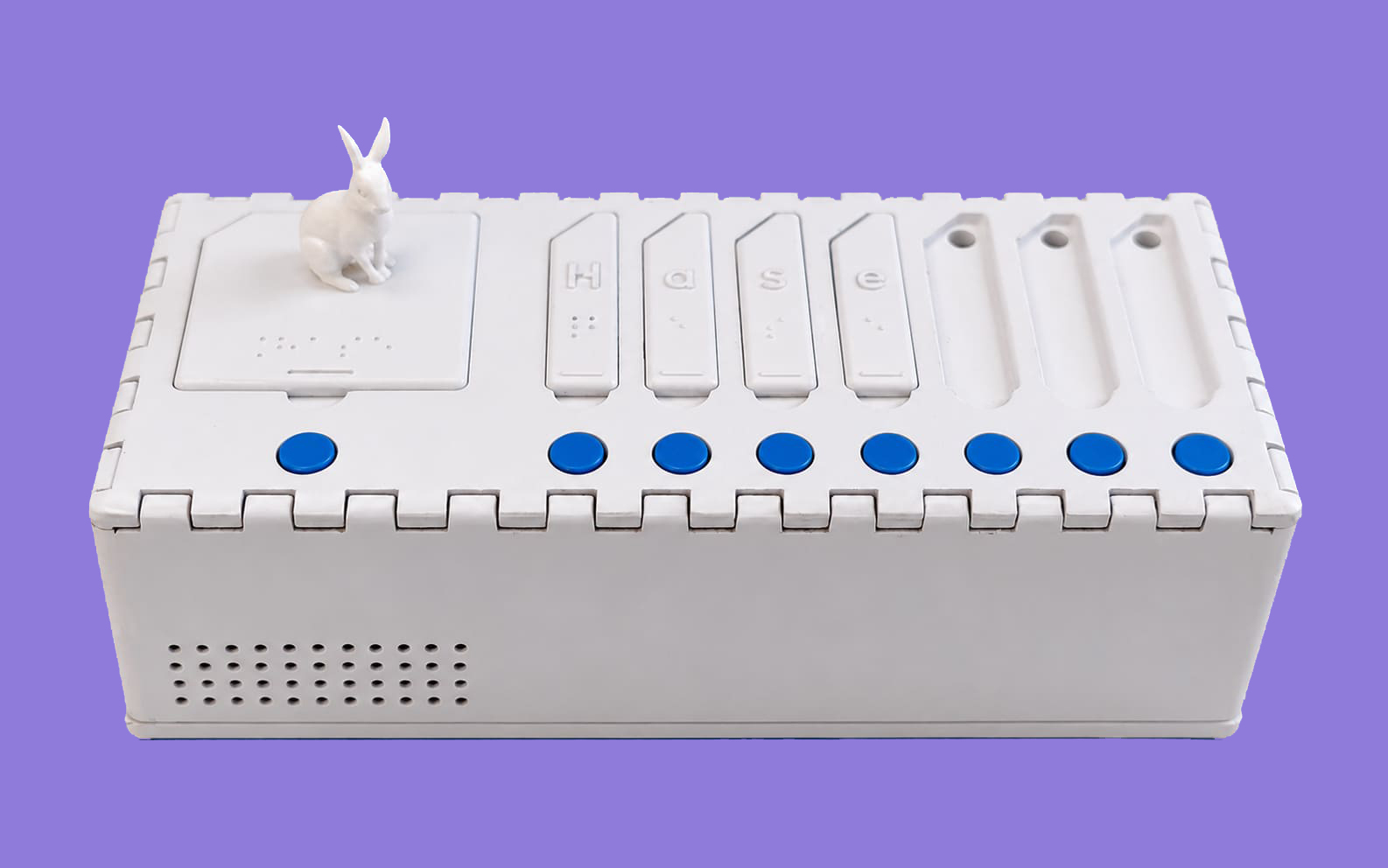
After several design iterations, I built Braillebuddy, a standalone, screenless learning device designed for early Braille learners. It consists of:
A wooden box with tactile slots and physical game cards
3D-printed Braille letters (in original DIN dimensions)
RFID and light sensors to detect card placement
Audio feedback via an embedded speaker
The implementation connects RFID/NFC tag recognition, physical input elements, and embedded audio feedback through an ESP32-based hardware setup, translating tactile interactions into immediate, accessible learning responses.
Children can play three example learning games:
Word Copy – replicate words presented as Braille + object cards
Word Scramble – rearrange letters into correct order
Word Riddle – guess a mystery word with limited clues
The prototype gives real-time auditory feedback and celebrates correct answers with sound effects.

Evaluation
In collaboration with a special education school, I evaluated Braillebuddy with eleven first to third grade students with visual impairment, who are currently learning Braille.
Even without training, the students showcased that the device is generally usable in an unsupervised manner. Further, the children enjoyed playing with the box, highlighting its intrinsically motivating nature.
Overall, our results show that Braillebuddy has the potential to be successfully integrated into the learning of Braille, specifically by offering children an opportunity to play with and explore Braille in an extracurricular fashion.

Impact
The main impact of Braillebuddy lies in its ability to support children in learning Braille through independent, hands-on exploration and a playful experience: children can touch, try, listen, make mistakes, and receive immediate feedback.
The project was published at CHI 2023, the leading international conference on Human-Computer Interaction, further underlining its relevance within the Human-Computer Interaction and accessibility research community. This is something I’m very proud of.
For more information you can read the full paper here: Braillebuddy: A Tangible User Interface to Support Children with Visual Impairment in Learning Braille